
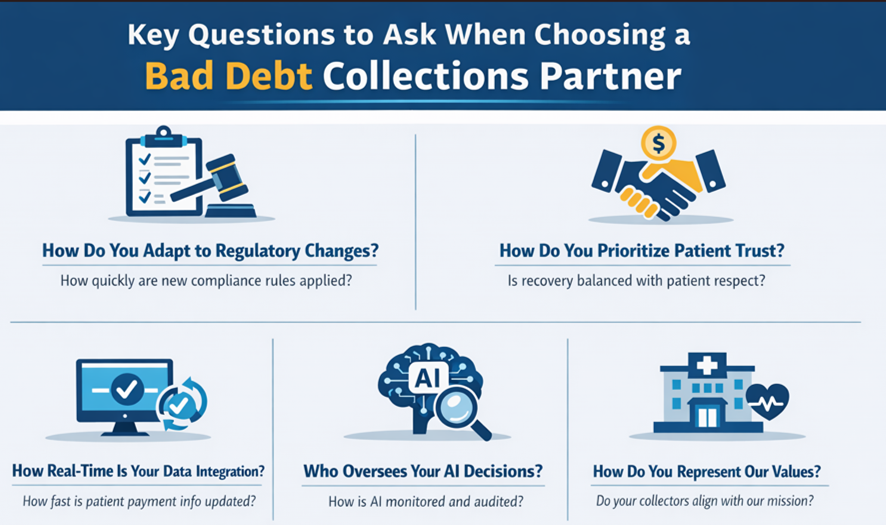
In 2026, the difference between a standard collection agency and a true revenue cycle partner isn’t defined by the technology they advertise. It’s defined by how they think. Technology matters. Integration matters. Artificial intelligence matters. But the real risk in bad debt strategy today isn’t a lack of tools. It’s misalignment — operational, regulatory, and reputational. Before selecting or renewing a collections partner, healthcare leaders may benefit from asking a different set of questions.
When regulations change, what actually happens operationally?
Any collection agency can say they are compliant. Fewer can clearly explain how compliance evolves in real time. When a state updates medical debt reporting rules or when charity care thresholds shift, how quickly do workflows adjust? Who makes that decision? How is it communicated and enforced? The trade-off leaders often underestimate is speed versus governance. A system that moves fast without oversight creates exposure. A system that requires excessive approval layers creates lag. Compliance is not a feature. It is a disciplined process.
Does your partner measure recovery — or financial trust?
Recovery percentage is a lagging indicator. Patient trust is cumulative. Digital outreach is now baseline. Omnichannel capability is expected. The more important question is whether outreach is precise or simply automated. Leaders should consider:
- How does the agency differentiate between temporary financial strain and long-term inability to pay?
- What triggers flexibility versus escalation?
- How is collector tone monitored and aligned with our brand?
Short-term recovery gains achieved through rigid or aggressive tactics can erode long-term patient loyalty. Precision and empathy increasingly outperform volume.
What happens when a patient pays you directly?

One of the most overlooked risks in bad debt strategy is payment lag between the provider and the agency. If a patient pays at your front desk or through your portal, how quickly does that information suppress outreach activity? This is not an IT detail. It is a patient experience safeguard.
Leaders should ask:
- Is integration real-time or batch-based?
- What is the latency between payment posting and outreach suppression?
- How is duplicate contact prevented?
Reputational friction often occurs not because of collection activity — but because of outdated data.
Who is governing your AI — and how?
Artificial intelligence is now embedded in revenue cycle operations. That reality brings both efficiency and responsibility. Instead of asking whether a partner uses AI, leaders may ask:
- Who audits automated segmentation and outreach decisions?
- How are financial assistance policies reflected in those models?
- Is there human oversight in edge cases?
- Can decision logic be explained if questioned?
Efficiency without explainability introduces risk. Governance determines whether AI strengthens performance or undermines it.
Are you selecting a vendor — or extending your business office?
A collections partner is not a downstream silo. They are an extension of your revenue cycle culture. When evaluating a partner, consider:
- Do their workflows reflect your financial assistance philosophy?
- Do their collectors represent your organization with consistency?
- Do they proactively surface risk, or react when prompted?
Technology is infrastructure. Judgment is differentiation.
Closing Reflection
The most sophisticated collections technology is ultimately the technology you do not have to worry about. As regulatory pressure and patient expectations continue to evolve, bad debt strategy must balance margin protection with brand integrity. Leaders who ask better questions about governance, integration discipline, and operational alignment are more likely to build resilient partnerships.
In 2026, the defining question may not be whether a partner can collect — but whether they can think alongside you.