

The healthcare RCM landscape in 2025 was marked by heightened regulatory scrutiny, increased claims complexity, and a profound shift toward predictive enforcement; increasing the risks of non-compliance. In this environment, viewing compliance* as a burdensome overhead is a perilous miscalculation. Substandard compliance efforts no longer just risk fines; they threaten the fundamental financial viability of healthcare organizations.
The true cost of RCM non-compliance extends far beyond punitive settlements. It is a multi-layered drain encompassing direct fines, lost revenue, and crippling operational inefficiencies. (*Healthcare revenue cycle compliance refers to the policies, controls, and processes that ensure billing, coding, collections, and patient financial communications adhere to federal and state regulations.)
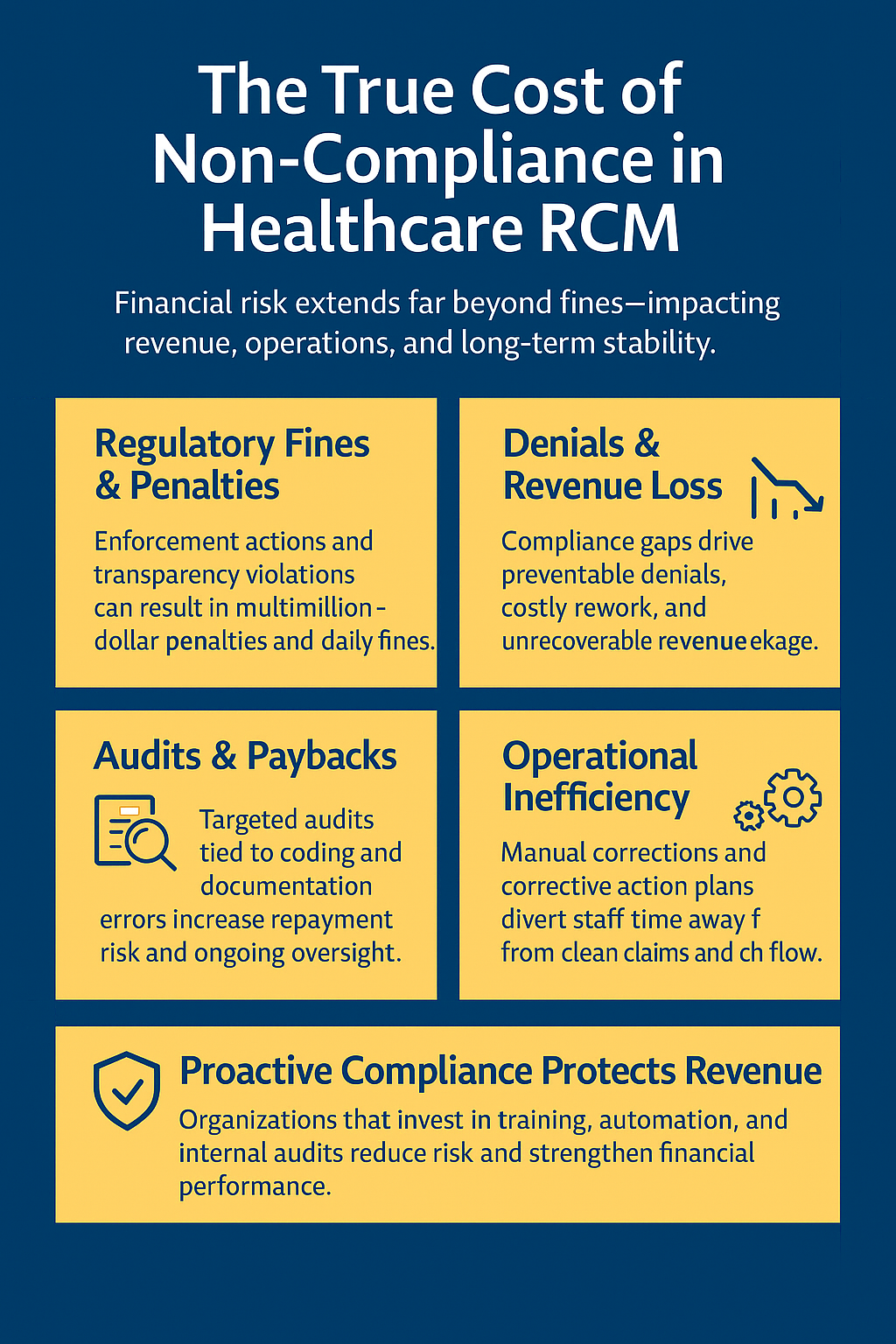 The Audited Price Tag: Non-Compliance Fines and Settlements
Federal and state enforcement agencies, primarily the Office of Inspector General (OIG) and the Office for Civil Rights (OCR), are leveraging sophisticated data analytics to identify fraud, waste, and abuse with unprecedented speed.
The monetary stakes have never been higher:
- Massive Enforcement Action: The HHS-OIG’s Spring 2025 Semiannual Report highlights the sheer scale of government oversight, with the agency’s enforcement and oversight activities resulting in a total monetary impact of $16.61 billion during a six-month period. This staggering figure underscores the agency’s focus on recouping taxpayer funds lost to improper payments.
- Maximum HIPAA Penalties: For compliance failures involving the handling of Protected Health Information (PHI), the financial threat remains severe. For willful neglect that is not corrected within 30 days (Tier 4), the maximum annual penalty can reach $2,134,831 per violation category, according to the updated fine structure for 2025.
- The Rise of Transparency Fines: New regulatory changes are cementing the mandate for patient financial clarity. For instance, non-compliance with Price Transparency Enforcement is now subject to potential fines of up to $10,000 per day. These daily penalties can quickly eclipse annual operating budgets.
The Invisible Drain: Lost Revenue and Operational Friction
While headline fines grab attention, the most significant long-term financial pressure often comes from systematic RCM inefficiencies rooted in poor compliance and quality control.
- The Denials Crisis
A lack of proper training and pre-submission scrubbing—critical elements of a strong compliance program—manifests directly as denied claims.
-
- Overall Revenue Loss: Revenue cycle inefficiencies could cost healthcare providers up to $16.3 billion in lost revenue in 2025 alone. This loss is often unrecoverable or requires immense resources to recoup.
- Cost to Rework: According to HFMA data, each denied claim costs providers approximately $118 to fix. This cost includes staff time spent researching, correcting, and resubmitting claims, diverting valuable labor away from clean claims processing.
- Targeted Audits and Coding Errors
The government is increasingly focused on high-risk coding areas. The OIG’s focus on Hierarchical Condition Category (HCC) coding is a prime example. In one recent semiannual report, $208 million in HCC-related overpayments were identified due to unsupported or inconsistent diagnoses coding Errors in these high-value coding areas lead directly to paybacks and costly future audits.
The Return on Investment (ROI) of Proactive Compliance
The ultimate lesson of the 2025 regulatory climate is that proactive investment in compliance is a defense against financial failure. The presence of a mature, functioning compliance program is consistently recognized by enforcement agencies during investigations.
Studies and OIG guidance show that having effective compliance programs can reduce penalties by 25-50% in the event of an investigation or settlement.
A robust RCM compliance strategy focuses on three core areas:
- AI and Automation: Utilizing machine learning for pre-submission claim scrubbing and real-time validation to catch errors before they become denials or non-compliant submissions.
- Training and Documentation: Ensuring that clinical documentation supports the codes billed and that staff are continuously educated on complex rules like the No Surprises Act enforcement and annual ICD/CPT code updates.
- Audit Defense: Conducting regular internal audits that follow the OIG’s seven core elements framework, positioning the organization to demonstrate “good faith” effort if an external review occurs.
Conclusion: Compliance as a Business Imperative
The ultimate lesson of the 2025 regulatory climate is that proactive investment in compliance is a defense against financial failure. The presence of a mature, functioning compliance program is consistently recognized by enforcement agencies during investigations.
Studies and OIG guidance show that having effective compliance programs can reduce penalties by 25-50% in the event of an investigation or settlement.
A robust RCM compliance strategy focuses on three core areas:
- AI and Automation: Utilizing machine learning for pre-submission claim scrubbing and real-time validation to catch errors before they become denials or non-compliant submissions.
- Training and Documentation: Ensuring that clinical documentation supports the codes billed and that staff are continuously educated on complex rules like the No Surprises Act enforcement and annual ICD/CPT code updates.
- Audit Defense: Conducting regular internal audits that follow the OIG’s seven core elements framework, positioning the organization to demonstrate “good faith” effort if an external review occurs.